
Morning at Chisos Mountains, Big Bend National Park
Exploring the Amazing Visual Landscape of West Texas
A Road Trip to Guadalupe Mountains and Big Bend
West Texas is one of the most visually distinctive regions in the United States. It’s enormous, sparsely populated, and defined by distance and light in ways that feel increasingly rare in modern America. From the limestone walls of Big Bend to the high peaks of the Guadalupe Mountains and the shifting dunes of the Permian Basin, this corner of Texas is too large to be understood as a single destination. It’s a landscape that unfolds gradually, revealing itself over distance and time.
Make no mistake, large portions of it can feel monotonous at first glance, which is one reason it remains overlooked. While national parks in Utah and Arizona attract millions of visitors each year, the desert landscapes of West Texas remain comparatively quiet. But scattered within that vastness are places of remarkable character. Those who make the journey often discover the same thing: some of the most dramatic scenery in the United States exists here, largely unnoticed.
The landscape is defined by scale and simplicity. Mountains rise abruptly from desert floors that stretch for miles. Light travels across open space before touching stone. The environment feels elemental—shaped by geology, climate, and time more than by human development.
The best way to understand it is not through a single destination, but through the road itself.
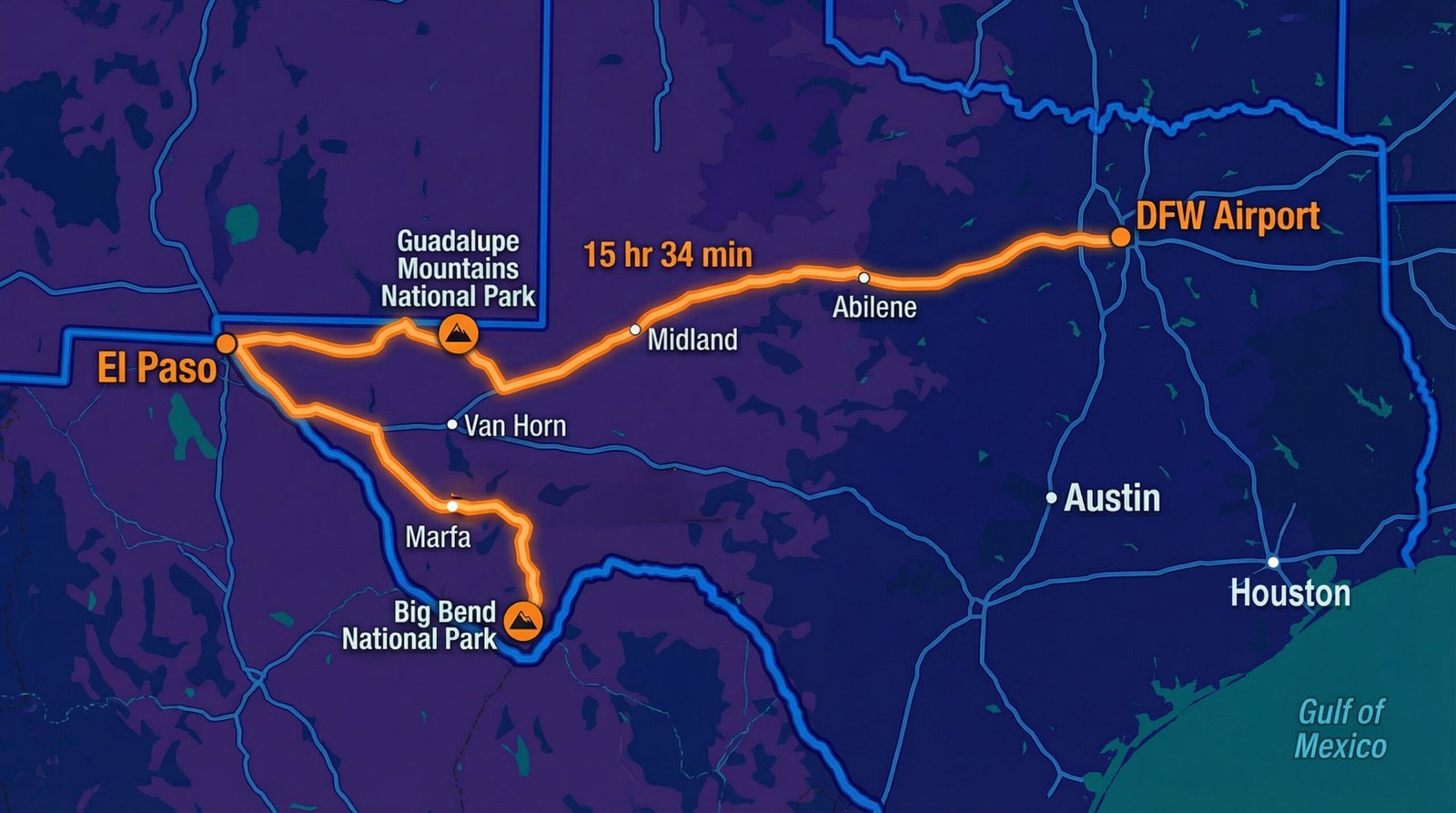
Beginning the Journey
This is a region measured in distance.
Texas is large in a way that only becomes clear when you drive it. The journey from Dallas–Fort Worth to the far western edge of the state covers roughly 630 miles—about 9 to 10 hours without significant stops—and never leaves Texas. It’s comparable to driving from Paris to Berlin or from New York City to Chicago.
Leaving the Dallas–Fort Worth Metroplex, development gives way quickly to farmland and prairie. Traffic thins. Towns become smaller and farther apart. West of Abilene, the horizon begins to widen.
This is the edge of the Llano Estacado, a vast plateau that stretches across West Texas and into eastern New Mexico. Early Spanish explorers referred to it as the “Staked Plain,” a name that likely came from the practice of marking travel routes across an otherwise featureless landscape. Even today, the region carries that same sense of openness and disorientation.
The sky becomes a dominant feature here. Storm systems build vertically. Sunsets stretch across miles of unobstructed horizon. The road appears to run indefinitely forward.
And then, gradually, the land begins to change.
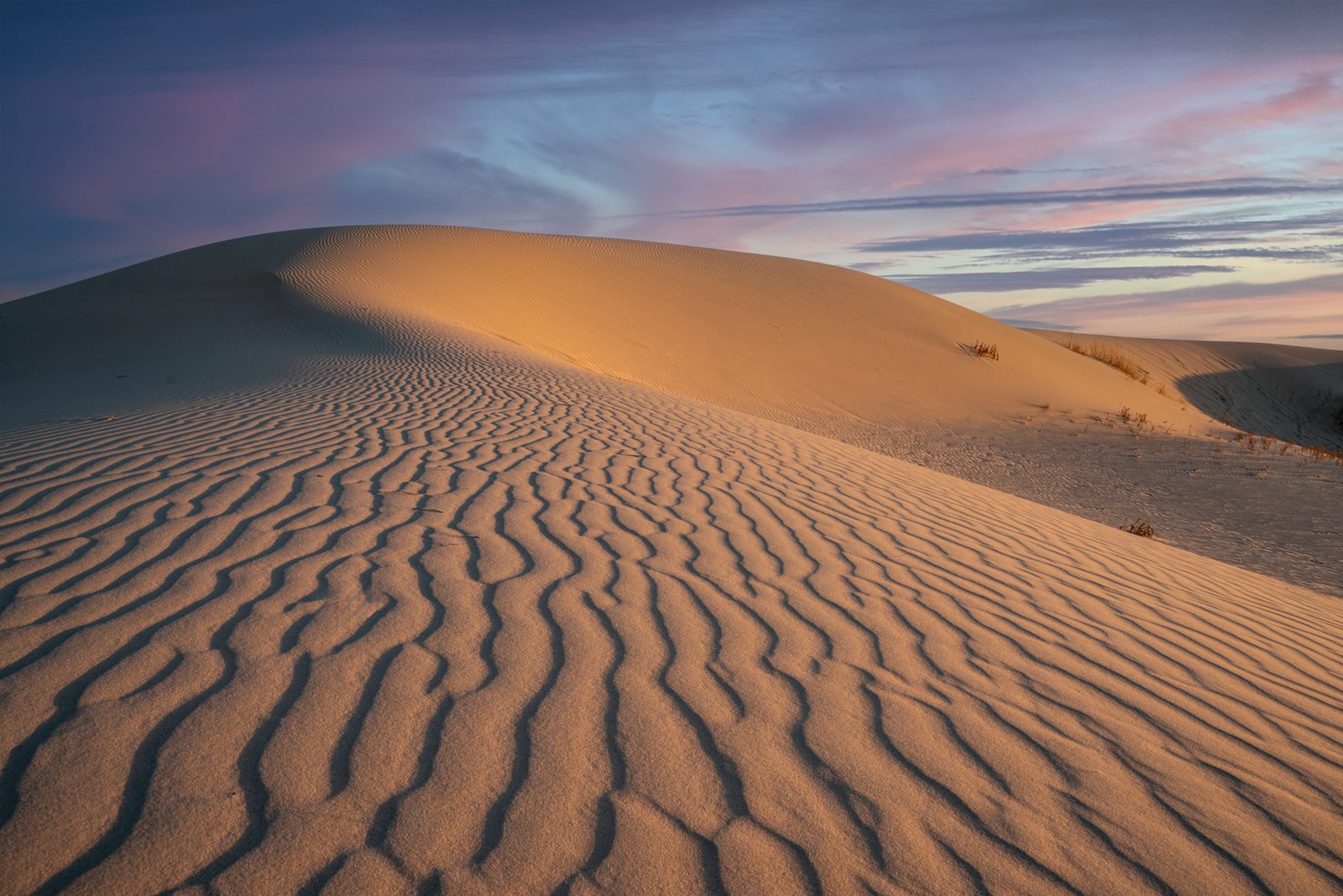
Monahans Sandhills State Park
Monahans Sandhills State Park: The Moving Dunes of West Texas
Several hours into the drive, the landscape shifts again as you enter the Permian Basin—one of the most productive oil regions in North America. Midland and Odessa rise from the desert as modern energy hubs, shaped by decades of oil production that have defined both the regional economy and much of Texas’ modern growth.
Pumpjacks move in steady rhythm across the landscape. Storage tanks and drilling rigs dot the horizon. The infrastructure of energy is constant and visible. Then, just west of Monahans, the terrain changes abruptly. The plains give way to sand. Monahans Sandhills State Park sits atop ancient windblown deposits that have accumulated over thousands of years. Unlike fixed dune systems, these dunes are active—constantly reshaped by wind. The result is a landscape that is never exactly the same from one day to the next.
The dunes rise in soft, rolling forms—thirty to forty feet high—creating a terrain that feels disconnected from the surrounding oil fields. Vegetation is sparse but adapted, with grasses and shrubs anchoring parts of the sand in place. Standing on a dune reveals a surprisingly expansive view. The terrain undulates toward the horizon, broken only by scattered plant life and open sky. It is a landscape defined by minimal elements—sand, light, and space—and by constant change driven by wind.
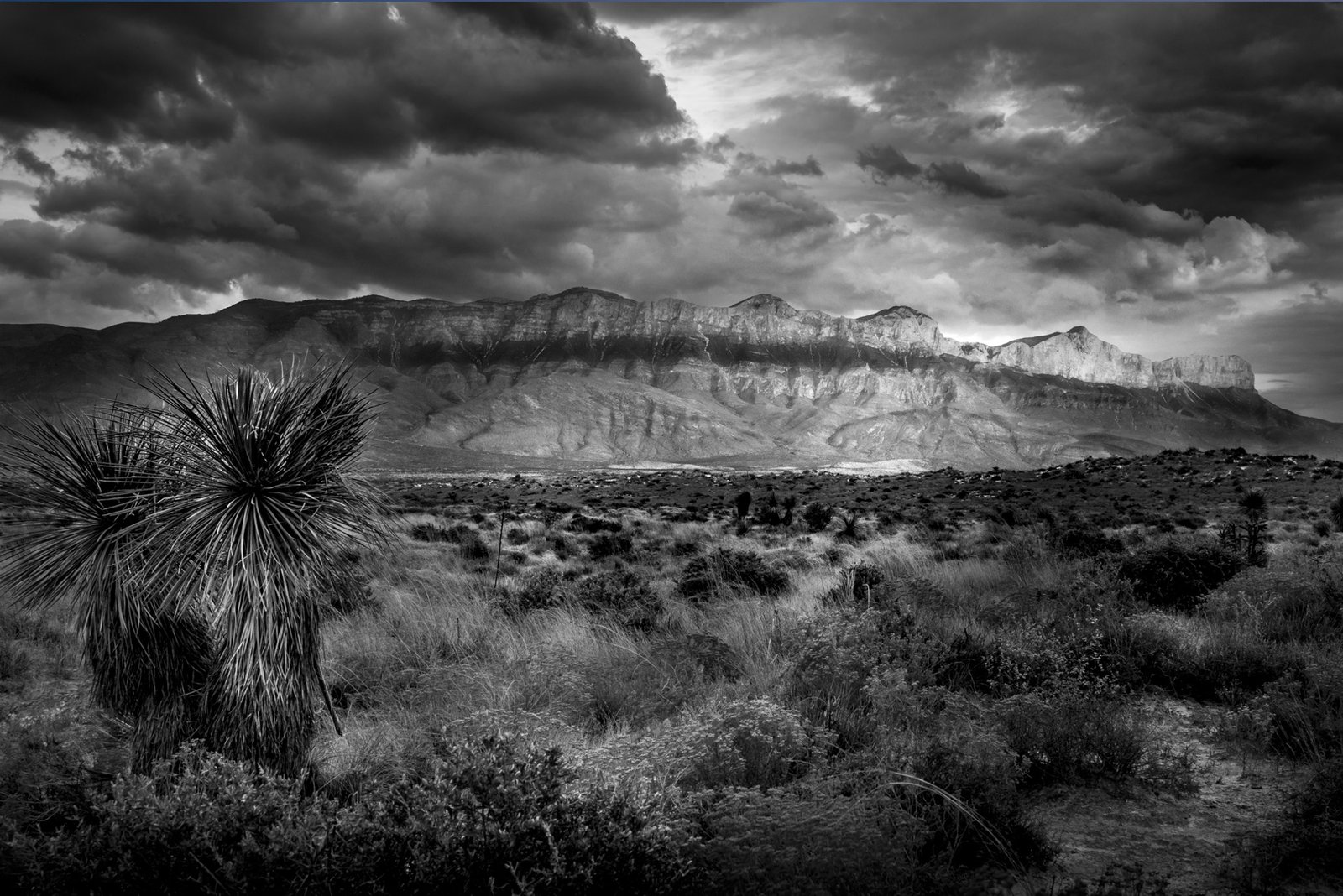
Salt Basin Overlook, Guadalupe Mountains National Park
Guadalupe Mountains National Park: The Highest Peaks in Texas
Continuing west, the horizon shifts again. After hours of flat terrain, a dark outline appears in the distance—the Guadalupe Mountains.
These mountains are the exposed remains of an ancient reef system formed during the Permian Period, more than 250 million years ago, when this region was covered by a shallow inland sea. Over time, tectonic uplift exposed the fossilized reef, creating the dramatic limestone formations visible today. At the center of the range is Guadalupe Peak, rising to 8,751 feet—the highest point in Texas. Despite the state’s reputation for flat terrain, its highest elevation exceeds that of the highest points in the majority of U.S. states.
El Capitan, a massive limestone formation on the southern edge of the range, served as a landmark for travelers along the Butterfield Overland Mail route in the mid-19th century. For those crossing the desert, it marked proximity to water and passage through the mountains.
Nearby McKittrick Canyon offers a contrasting environment. Sheltered by steep canyon walls, it supports vegetation rarely associated with West Texas, including maples and other deciduous trees. In autumn, the canyon becomes one of the most distinct seasonal landscapes in the state. Even from the base of the mountains, the scale is immediately apparent. The vertical relief, after hundreds of miles of plains, feels abrupt and defining.
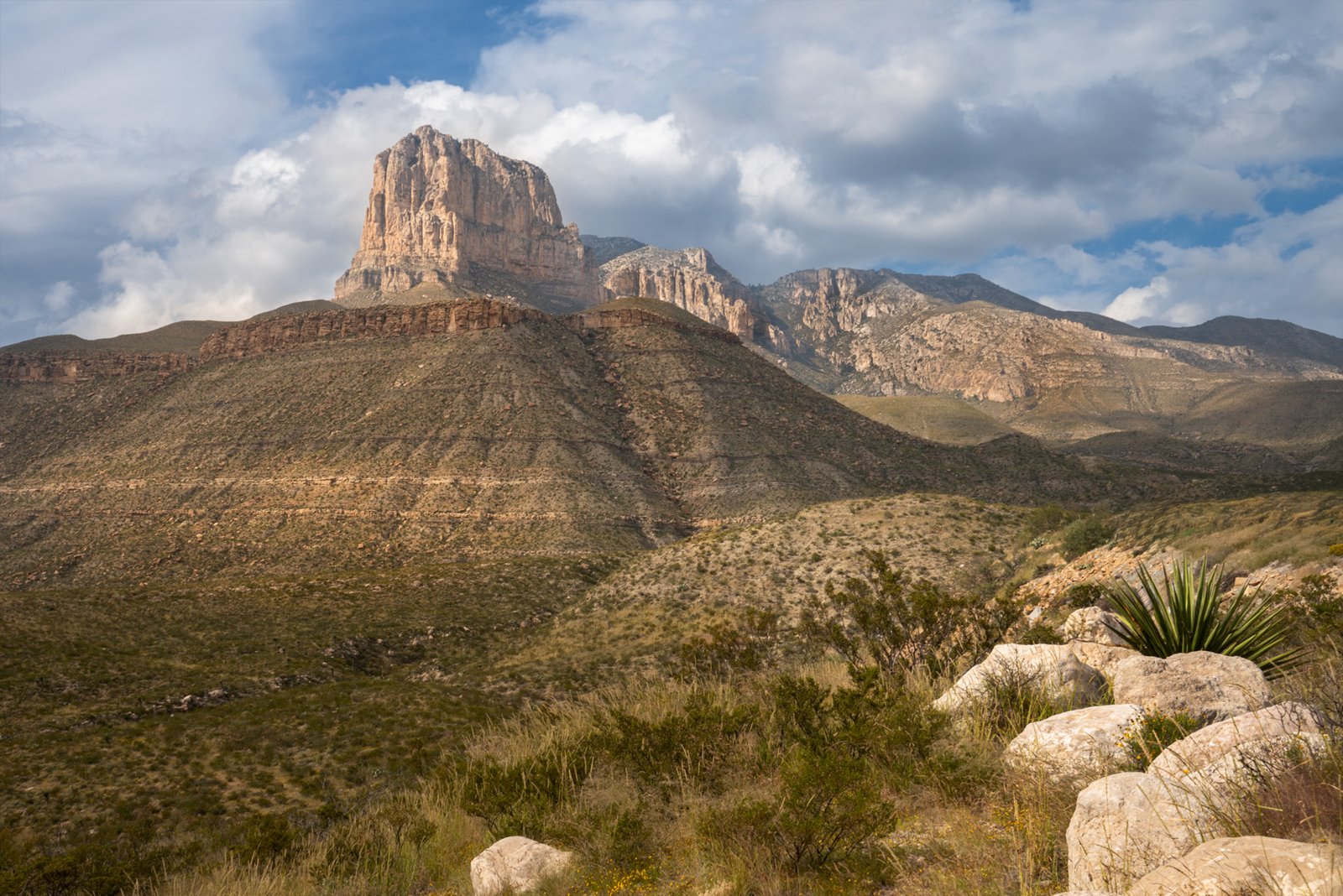
El Capitan, Guadalupe Mountains National Park
A Worthwhile Detour: El Paso and the Edge of Texas
A short detour west leads to El Paso, located at the intersection of Texas, New Mexico, and Mexico along the Rio Grande.
El Paso sits within the Chihuahuan Desert and is defined by the Franklin Mountains, which run directly through the city and form one of the largest urban state parks in the United States. From Scenic Drive, the view extends across an international landscape into Ciudad Juárez.
This is a region shaped as much by shared geography as by political borders. The Rio Grande, which serves as the boundary between the United States and Mexico in this area, is less a barrier than a defining geographic feature connecting both sides.
Culturally, El Paso reflects centuries of movement and exchange across that border. Spanish colonial influence, Mexican heritage, and American development all intersect here. The result is a city where architecture, food, and daily life reflect a layered regional identity rooted in place rather than boundary.
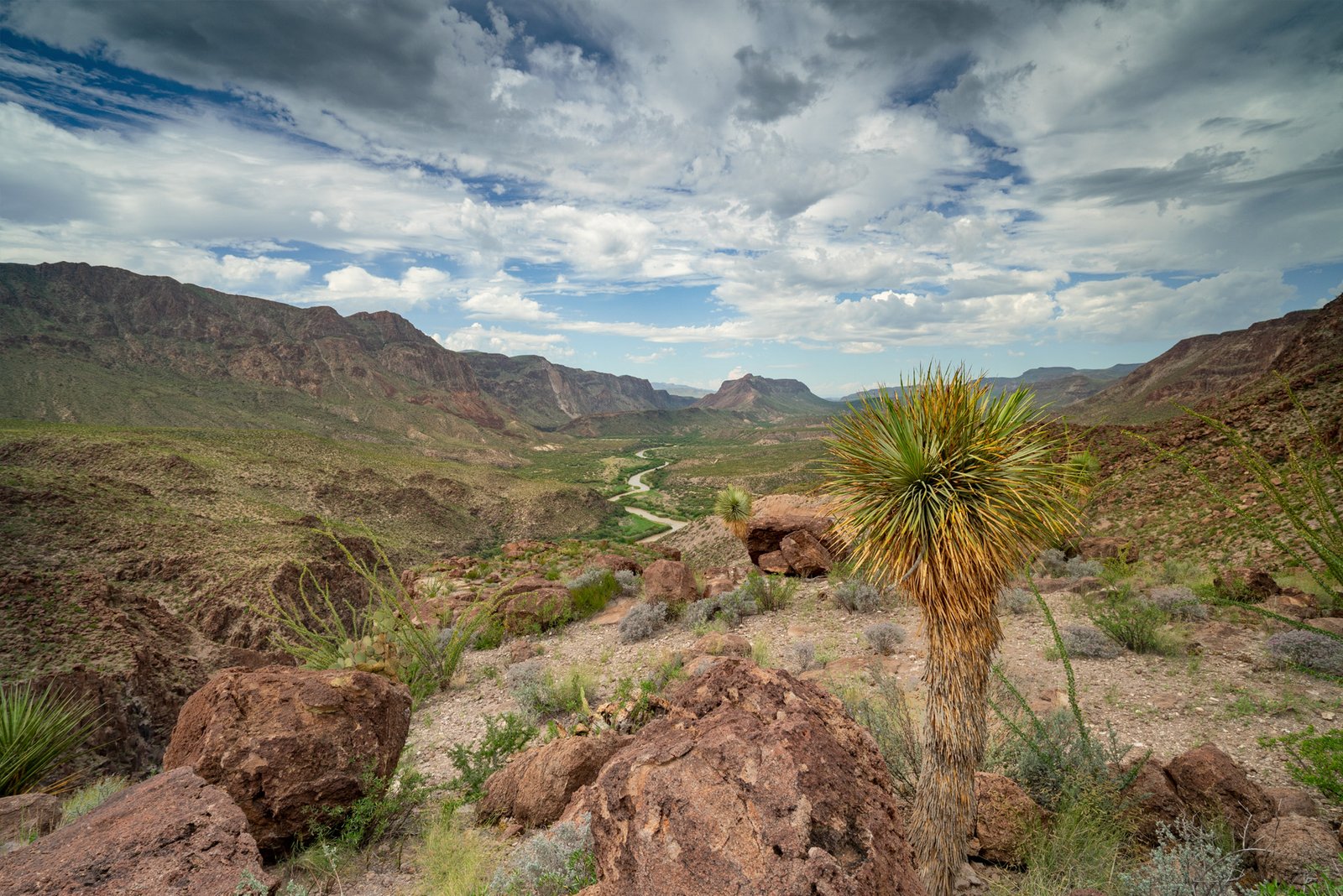
The Rio Grande near Big Bend Ranch State Park
Big Bend Ranch State Park: Texas’ Largest Wilderness
Turning south and east, the landscape becomes more rugged as the highway enters deeper desert.
Big Bend Ranch State Park covers more than 300,000 acres, making it the largest state park in Texas. Unlike the limestone formations of the Guadalupe Mountains, this region is dominated by volcanic geology. The terrain is defined by jagged ridges, dry washes, and layered rock formations shaped by ancient volcanic activity. One of the most notable features is El Solitario.
The Solitario is a collapsed volcanic dome roughly ten miles across, forming a circular mountain structure around a central basin. The formation reveals the underlying geological processes that shaped the Chihuahuan Desert—uplift, collapse, and erosion over millions of years. From its rim, the scale of the structure becomes clear. The landscape folds inward toward the center, creating a sense of depth that contrasts with the surrounding open desert.
Visitation here is low, and the sense of isolation is significant. The environment is defined by distance, silence, and exposure.
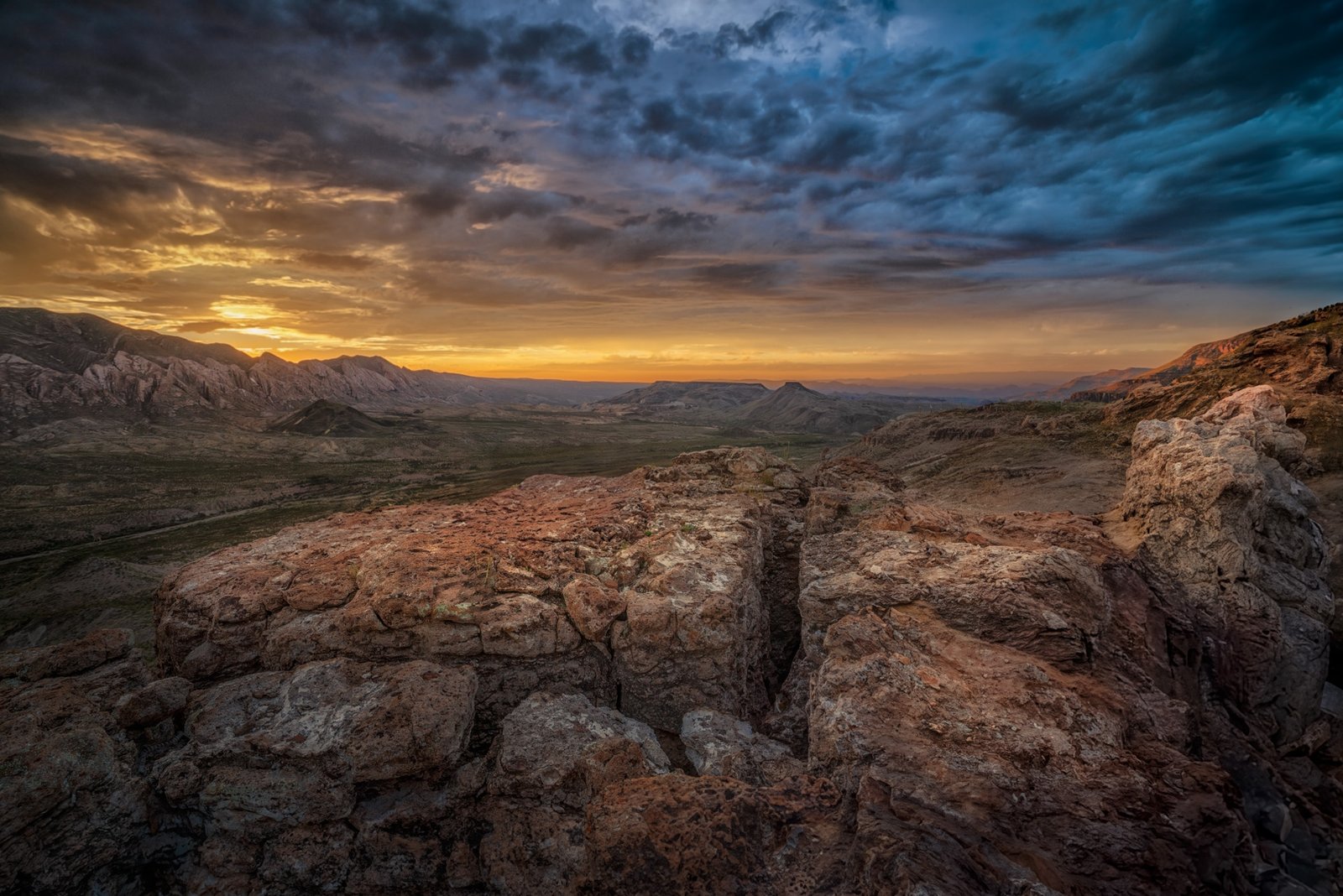
Sunrise over El Solitario, Big Bend Ranch State Park
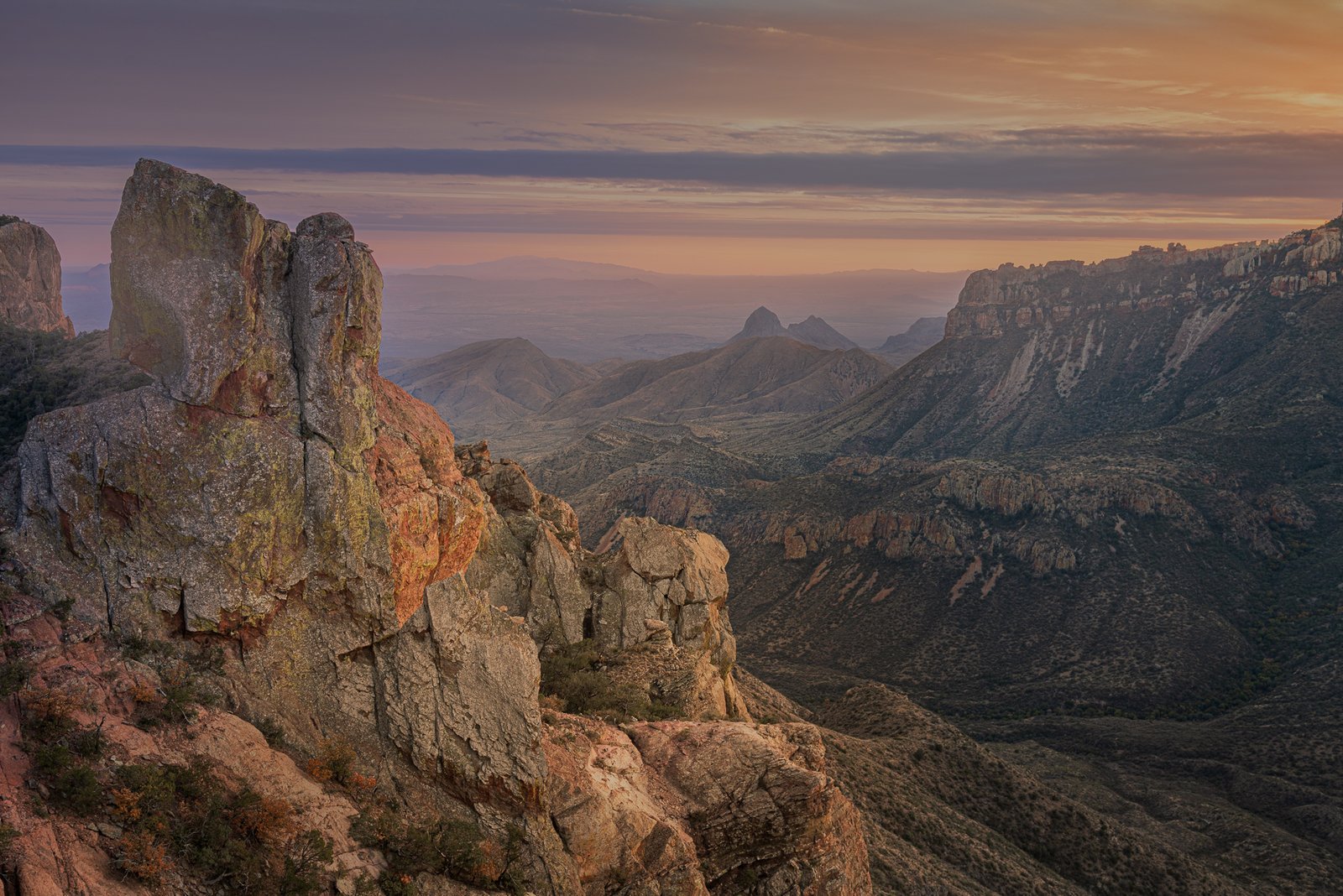
Just after sunset at the peak of Lost Mine Trail, Big Bend National Park
Big Bend National Park: The Quiet Giant
Continuing east, the road leads into Big Bend National Park. Covering more than 800,000 acres, Big Bend is one of the largest national parks in the contiguous United States. It is also one of the least visited, largely due to its remote location in far West Texas.
The park sits within the Chihuahuan Desert and is defined by the bend of the Rio Grande, which forms the southern boundary between the United States and Mexico. What makes Big Bend distinct is its ecological diversity. Within a single park, three major environments coexist:
-
Desert basin
-
Mountain range (Chisos Mountains)
-
River canyon (Rio Grande corridor)
The Chisos Mountains rise from the desert floor as an isolated range, creating a “sky island” ecosystem where elevation allows for cooler temperatures and different vegetation than the surrounding desert.
Distances within the park are substantial. It is common to drive 30 miles or more between key locations. The landscape reveals itself gradually, requiring time and movement to fully understand.
Iconic Landscapes of Big Bend
For photographers, Big Bend offers a remarkable variety of scenes.
- The Lost Mine Trail provides one of the most spectacular overlooks in the park, especially at sunset when the surrounding peaks glow gold above the desert.
- The Window Trail frames the desert horizon through a narrow V-shaped opening in the mountains.
- In the Grapevine Hills, the short hike to Balanced Rock leads through massive volcanic boulders before revealing one of the park’s most recognizable formations.
- But perhaps the most unforgettable scene lies along the Rio Grande. At Santa Elena Canyon, the river slices through limestone walls that rise fifteen stories above the water. It’s one of those places where people who didn’t plan to take pictures find themselves reaching for a camera
Several locations illustrate the range of environments within the park:
-
The Lost Mine Trail provides elevated views across the Chisos Basin, where the relationship between mountain and desert becomes clear.
-
The Window Trail frames the desert horizon through a narrow opening in the mountains, emphasizing the transition between enclosed and open space.
Balanced Rock, located in the Grapevine Hills, sits among volcanic formations shaped by erosion over time. -
Along the Rio Grande, Santa Elena Canyon presents one of the most striking geographic features in the region. The river cuts through limestone walls that rise approximately 1,500 feet above the water, forming a narrow canyon that defines the international boundary. The scale, combined with the quiet flow of the river, creates a landscape that feels both contained and expansive at the same time.
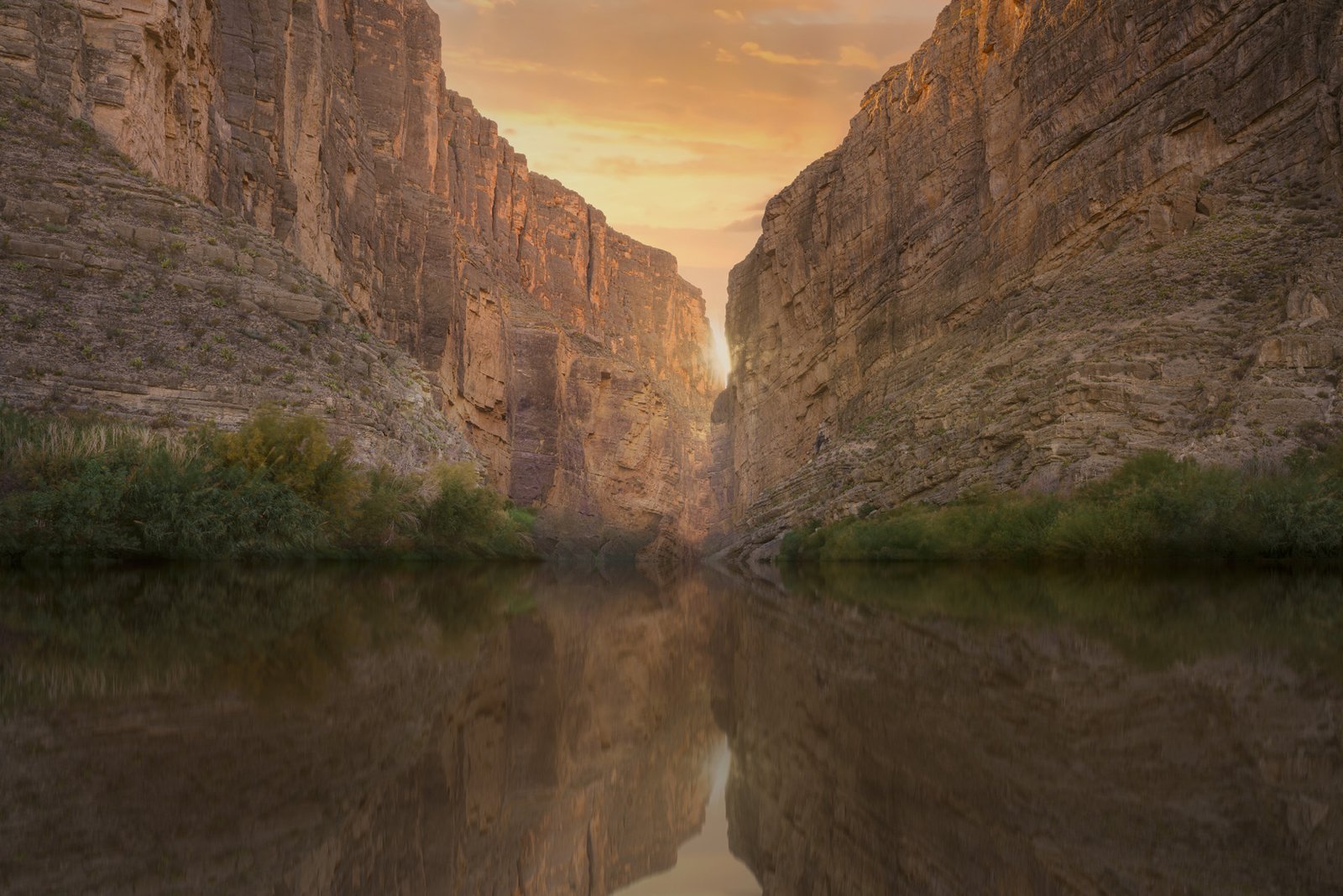
Santa Elena Canyon, Big Bend National Park
Why Big Bend Stands Apart
What distinguishes Big Bend is not just its scenery, but the way it is experienced. The landscape does not reveal itself immediately. It builds over distance—through gradual transitions in terrain, elevation, and scale. Movement through the park becomes part of understanding it.
Equally important is the absence of crowd density found in more accessible national parks. The space allows for stillness. Time is not structured around lines or congestion, but around light, distance, and observation. This changes how the landscape is perceived. It encourages a slower, more deliberate way of moving through the environment.
West Texas: A destination like no other
Big Bend may be the focal point, but it is only part of a larger system. West Texas as a whole is defined by progression. Plains transition into desert. Desert gives way to mountains. Mountains break into canyons. Each shift is gradual, and each is shaped by underlying geology and climate.
It is not a region defined by a single landmark. It is defined by the space between them. The value of West Texas lies in that movement—in the miles of road, the changing light, and the subtle transitions that become visible over time. It requires patience. It rewards attention. And it offers a form of landscape experience that is increasingly difficult to find.
Big Bend may be the destination, but the experience is everything leading up to it—and everything surrounding it. Because in West Texas, the landscape is not something you arrive at. It is something you move through, study, and gradually come to understand.